In my recent conversations with the companies I advise, one common yet profound question keeps showing up:
I am ready to run AI in production today, but...
- Where will it genuinely earn trust? Conversational use cases, agentic task automation, deep data use cases, or prediction models?
- Where will hallucinations force redesigns or rollbacks? Are there still hallucinations we are not accounting for?
- How do we explain AI uncertainty to executives, customers, and regulators?
Have you not faced this pattern?
- The demo looks impressive.
- The pilot shows promise.
- Then someone asks the uncomfortable question: What happens when this is live?
If you have deployed large language models in production, especially in customer-facing, analytical, or decision-support workflows, you already know the answer is not simple.
The Hallucination Reality (Still Here, Still Measurable)
AI hallucinations are not a fringe issue or just an early-model problem. They remain a core limitation of LLM systems, even among advanced models.
Multiple independent benchmarks continue to show:
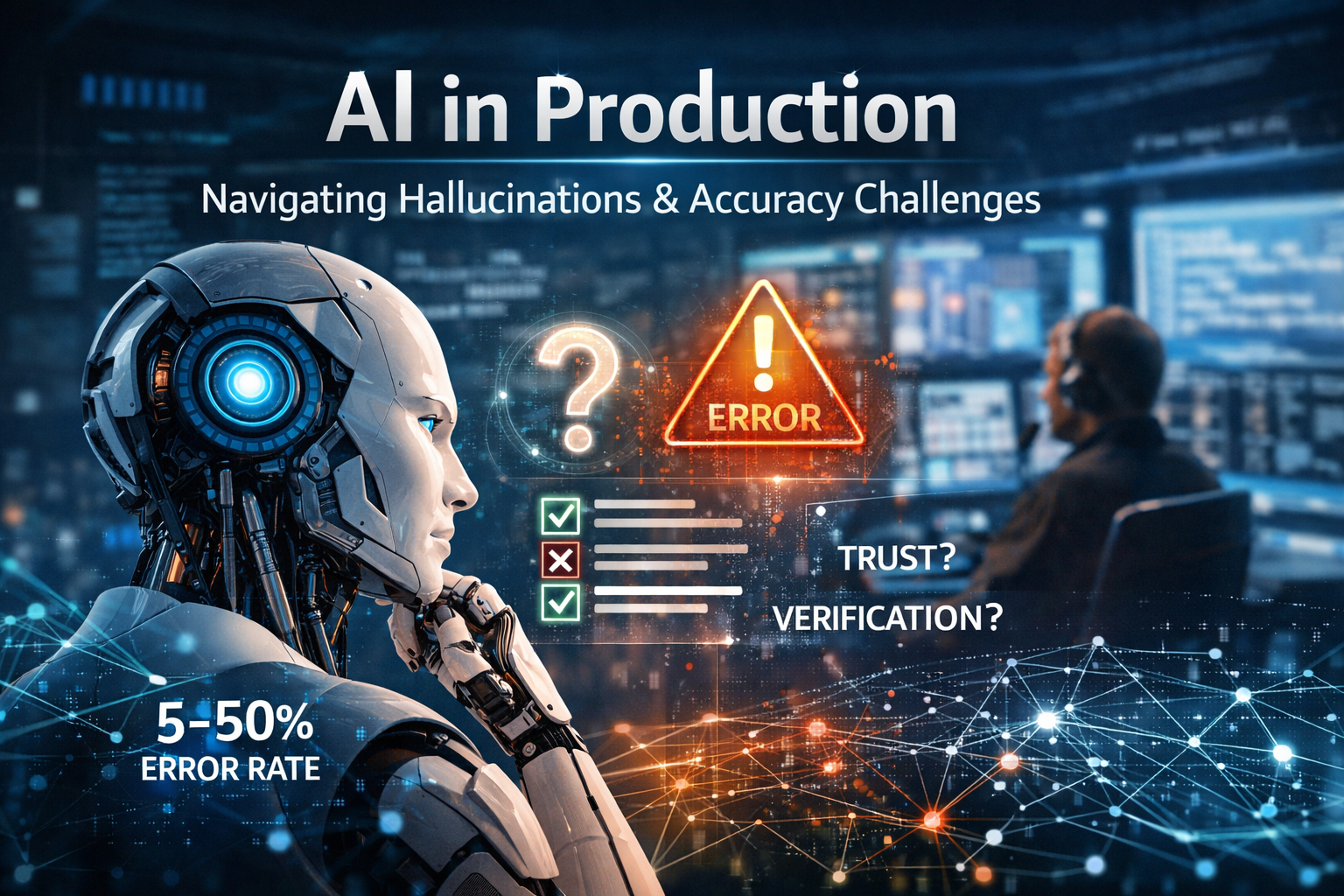
- Hallucination rates from around 5% to over 50%, depending on task and domain
- Reasoning-heavy and factual-verification tasks often in the 15-30%+ error range
- Summarization evaluations with error rates in the 33-48% band for some leading models
- Domain-heavy contexts (CLM, CPQ, supply chain, reverse logistics) often exceeding 30%
These numbers are not meant to scare. Most teams already see this in AI-led solutions. The bigger issue I observe across organizations is a widening gap:
- AI is astonishingly capable in exploration, synthesis, and speed
- Trust collapses when outputs are treated as authoritative without guardrails
In production, even a 5-10% error rate can be unacceptable, or can demand deep downstream explanations, depending on customer impact, regulatory exposure, and decision criticality.
Findings from Founder Conversations
I am seeing a few patterns emerge:
- Human-in-the-loop workflows for high-risk decisions
- Selective use-case deployment
- Clear UX signaling that outputs may be incomplete
But these are real trade-offs, and they bring us back to the core question: what is actually working, and what is not, in your world?
#AIInProduction #AIHallucinations #ResponsibleAI #EnterpriseAI #AITrust #AIGovernance #AgenticAI #ProductLeadership #FounderConversations #Execution